
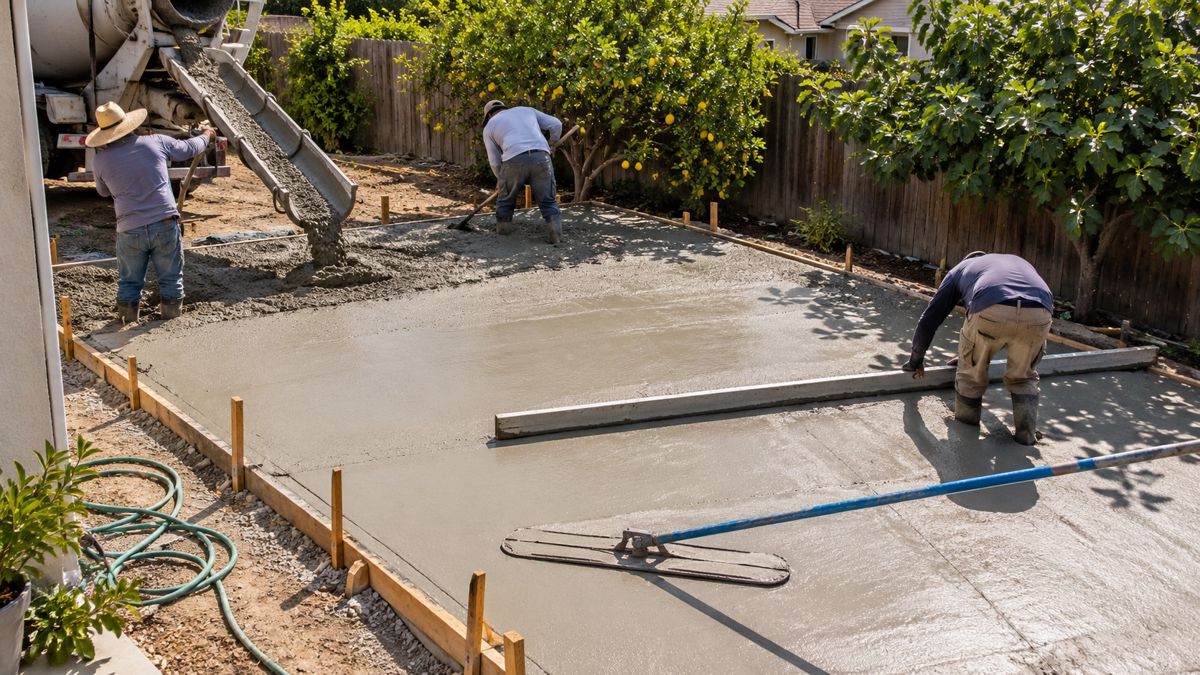
For a basic broom-finish slab, many California homeowners see prices of roughly $6 to $12 per square foot installed. Stamped or decorative work often runs higher. These are rough market guides, not quotes from this business, and the real number depends on your site. Here is how the pieces add up in Sacramento.
What is the typical cost per square foot?
Concrete is priced by the square foot for flatwork, with thickness and finish built into that number. These are broad, rough guides for the wider market. Small jobs usually cost more per square foot, and big, simple pours cost less.
- Plain slab, patio or walkway: roughly $6 to $12 per square foot.
- Driveway, four to five inches thick: roughly $6 to $12 per square foot, higher with demolition or tight access.
- Stamped or colored concrete: often $12 to $22 per square foot or more.
- Removing old concrete: commonly adds a few dollars per square foot.
Foundations are different. They are priced from engineered plans, so there is no simple per-square-foot figure that fits every job.
What drives the price up or down?
Two slabs of the same size can have very different prices. These are the factors that matter most.
Thickness and reinforcement
A four-inch slab uses less concrete than a six-inch slab. Rebar or wire adds material and labor. Driveways for heavy trucks or RVs need more than a garden path does.
Site prep
Grading, a compacted rock base and the removal of old concrete take time. Soft soil, steep ground and tree roots all add work before any concrete arrives.
Finish and color
A simple broom finish is the most affordable. Exposed aggregate, color and stamped patterns need more skill, more material and more steps.
Access and delivery
If the truck can back up to the forms, the pour is simple. If the concrete must be moved in wheelbarrows or by a pump, labor and equipment costs go up. Very small loads can also add a short-load fee.
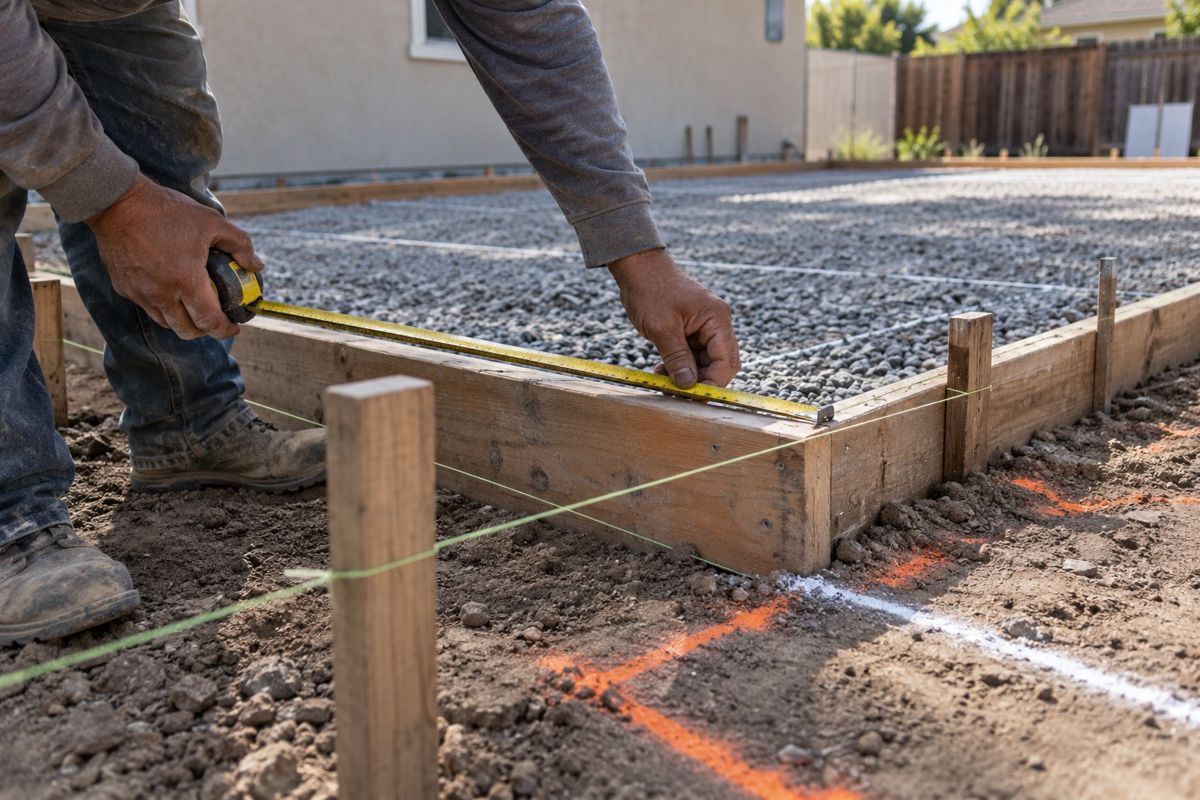
How much concrete does your project need?
Ready-mix concrete is sold by the cubic yard. One cubic yard covers about 81 square feet at four inches thick, and about 54 square feet at six inches. Contractors order a little extra for uneven ground and spills.
Here are a few rough examples using the guide above. They are illustrations, not offers.
- A 10 by 20 foot patio is 200 square feet. At $6 to $12, a basic slab might land around $1,200 to $2,400.
- A 20 by 20 foot driveway pad is 400 square feet and needs about five cubic yards. At the same range, that is roughly $2,400 to $4,800.
- A 20 by 30 foot driveway is 600 square feet. A rough range is $3,600 to $7,200.
- A 10 by 20 foot stamped patio at $12 to $22 might be about $2,400 to $4,400.
Real quotes can fall outside these ranges, especially for small jobs, hard access or extra demolition.
What is different about pouring concrete in Sacramento?
Local conditions affect both the method and the price.
- Summer heat: afternoons often pass 95 degrees. Crews start early and cure the slab so it does not dry too fast. That planning is part of the cost of doing it right.
- Clay soil: many areas have clay that swells and shrinks. A compacted rock base and proper joints help a slab stay flat.
- Tree roots: older neighborhoods such as Land Park and East Sacramento have large trees. Root work can add time to a driveway or walkway job.
- Permits: foundations and structural slabs usually need a building permit. Work in the public right of way, such as a driveway apron or sidewalk, may need city or county approval.
California also requires a contractor license for most work above a small dollar amount. You can look up a license on the state licensing board website before you sign anything.
What extra costs do homeowners forget?
Several items sit outside the basic per-square-foot number, and they are easy to miss when you first budget.
- Demolition and disposal: breaking out an old slab, loading it and paying to dump it.
- Drainage fixes: a French drain, a catch basin or regrading so water leaves the area.
- Sprinkler and utility work: moving irrigation lines or lowering a cover so the slab sits flush.
- Permit and inspection fees: mostly for foundations and structural slabs.
- Sealing: stamped and colored surfaces need a sealer now and again later, usually every two to three years.
Ask your contractor to list which of these are in the quote and which are not. A short conversation during the site visit prevents surprises on the final bill.
How do you compare concrete quotes fairly?
A low price can hide a thin slab or a skipped base. Use the same checklist for every bid.
- Ask for a written quote with the size, thickness and finish.
- Check that it lists the base material and reinforcement.
- See whether demolition and haul-away are included.
- Ask about joints, curing and sealing.
- Confirm who pulls any permit.
- Ask to see a valid California license and proof of insurance.
- Ask about the cleanup and the schedule.
If two quotes differ by a lot, find out why before choosing the lower one. The gap is often in thickness, base or demolition.
Which Sacramento concrete service fits your project?
Start with the project you have in mind. For a new or replacement drive, read about concrete driveway installation in Sacramento. For a backyard upgrade, see our stamped concrete patios. If you are fixing cracked or sunken concrete, our repair and resurfacing page explains the options.
When you are ready, send a few photos and the rough size of the area. We will visit, measure and give you a written quote for your site. Remember that every price in this article is a rough guide, and your own quote is the only number that counts.